Every water body grows shallower in time. Rivers and canals deposit sediment, reservoirs and harbours silt up, and a fairway that recently had the required depth stops meeting it. Dredging works — deepening and desilting — restore a water body’s parameters: transit depth, capacity and storage. We explain what they involve, what equipment is used and what to do with the spoil.
What dredging works are
Dredging is the removal of soil and sediment from the bed of a water body in order to deepen it or restore the design bed levels. It covers deepening (achieving a greater depth than before) as well as desilting and maintenance (removing accumulated sediment and restoring the original state). It is one of the basic maintenance tasks in water management and in ports.
Where it is carried out
- Waterways and harbour basins — maintaining the transit depth for navigation.
- Basins and quays — deepening at quays for larger vessels.
- Retention reservoirs and ponds — recovering storage lost to silting.
- Canals and drainage ditches — restoring capacity and flow.
- Rivers — clearing the channel, removing shoals and debris.
Methods and equipment
The equipment depends on the type of spoil, the depth, access to the water body and where the excavated material will go.
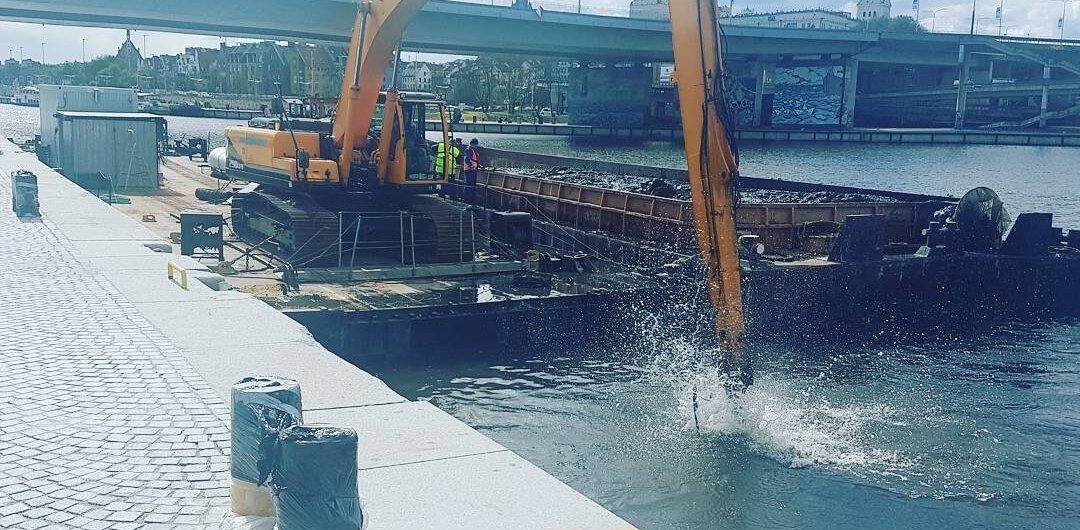
- Mechanical dredgers (grab, backhoe) — cohesive soils and coarse material; working from a pontoon or the bank.
- Suction and cutter-suction dredgers — sediment and loose soils; spoil pumped through a pipeline (reclamation).
- Long-reach excavators from the bank — smaller canals, ditches and the nearshore zone of reservoirs.
Spoil management
Spoil is not an “incidental” waste — it is often the hardest part of the task. The material has to be discharged, dewatered and either reused or stored in line with its characteristics. Clean sand can be used for reclamation (e.g. nourishing banks), while sediments require testing and proper handling. The way the spoil is managed is planned before the works begin, because it governs the logistics and the cost of the whole job.
Permits
Deepening and desilting are use of water and interference with the bed, so they usually require a water-law permit. Added to this are arrangements with the water authority, environmental issues (sediments, timing outside the spawning season) and — on navigable waters — arrangements with the navigation authority. This is a stage not to be underestimated: formal errors can halt works for a season.
FAQ
What is the difference between deepening and desilting?
Deepening increases depth beyond the original; desilting removes accumulated sediment and restores the design state. The technology may be similar, but the goal and scope differ.
What happens to the excavated spoil?
Depending on its characteristics — reclamation, dewatering and reuse, or storage. This is decided before the works.
Do you have a silted reservoir, canal or a water body to deepen? We will select the technology, plan the spoil management and prepare the documentation — from the water-law permit to delivery. Ask for a quote.