Wherever you need a vertical, watertight and load-bearing edge — along a quay, in an excavation next to water, or in a cofferdam separating the work site from the river — the usual answer is a sheet pile wall. It is one of the fundamental structures in hydrotechnical engineering: a set of interlocking profiles (sheet piles) driven into the ground to form a continuous barrier. We explain the types of sheet pile walls, how the profile is selected and what installation looks like in practice.
What a sheet pile wall is
A sheet pile wall is built from elements (sheet piles) joined at interlocks and driven or pressed into the ground to form a watertight, continuous barrier. It works as a retaining structure — carrying earth and water pressure — and as a barrier limiting seepage. Depending on the task it can be temporary (excavation support, a cofferdam for the duration of works) or a permanent part of a structure (quay, bank protection, abutment).
Types of sheet pile walls
Steel (Larssen sheet piles)
The most common and versatile. Hot-rolled sheet piles — often called “Larssen” after the U-profile — carry heavy loads and suit both temporary and permanent structures. They are used for quays, cofferdams, deep excavation support and abutments. The profiles can be recovered after temporary works or left in place as the final element.
Vinyl (PVC) and composite
Lighter, resistant to corrosion and aggressive water environments. They work well under lower loads — low quay walls, bank protection for ponds and canals, ditch linings. Cheaper to transport and install, but with limited load capacity compared to steel.
Reinforced concrete
Precast or cast in place, used where high durability and a massive retaining structure are required. Heavier and more expensive to build, hence reserved for tasks of appropriate scale.
Timber (historical)
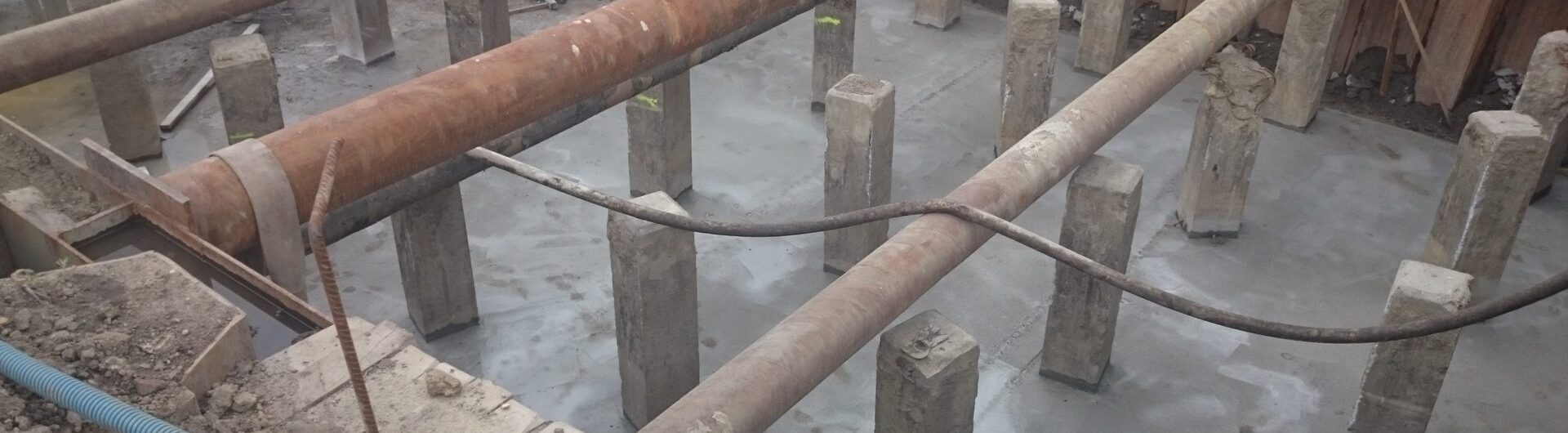
The oldest type. Before steel became widespread, timber sheet piles and piles were the basis of quay construction — and to this day a great many existing quays, jetties and bank protections rest on timber structures. After decades in the water they require assessment and often repair or replacement, which is why they are mostly encountered during quay renovations and the modernisation of older structures. Today timber is used less often, mainly in heritage structures and where a natural character of the bank matters, as it is inferior to steel in durability and capacity.
Where sheet pile walls are used
- Quays and marinas — a vertical retaining structure at the land–water interface (see quay renovation).
- Excavation support — deep excavations near water, buildings or infrastructure.
- Cofferdams — separating the work site from the water so it can be worked “in the dry”.
- Bank protection — a vertical bank where there is no room for a slope (see riverbank protection).
- Abutments and culverts — elements of bridge and hydrotechnical structures.
- Cut-off barriers — limiting groundwater flow.
Selecting the profile
The profile is decided by statics, not by the price list. Factors include the wall height and embedment depth, earth and water pressure, service loads (surcharge, traffic, mooring), ground and water conditions, and whether the structure is temporary or permanent. For greater heights the wall is additionally anchored or braced to limit deflection. Too weak a profile means excessive deflection or loss of stability — and fixing that afterwards costs many times more than getting it right at the design stage.
Installation methods
- Vibratory driving — the fastest and most common method; vibration reduces ground friction and lets the pile in. The effect of vibration on neighbouring buildings must be controlled.
- Static pressing (vibration-free) — piles pressed in by hydraulic rams, with no vibration or noise; a solution for dense urban areas and sensitive structures.
- Impact driving — in difficult ground, where vibration is insufficient.
The method depends on the ground, the surroundings and the requirements regarding vibration and noise. In built-up areas the impact on adjacent structures is usually the deciding factor.
Permits
A sheet pile wall in the channel, on the bank or within the range of waters is usually a water device or work requiring a water-law consent. In practice this may mean a water-law permit, and for smaller tasks — a water-law notification. The documentation is best prepared in parallel with the structural design, so formalities do not stall the works.
FAQ
What is a Larssen sheet pile?
A steel U-profile interlocked into a continuous wall. “Larssen” is a common name derived from the profile type, now used generally for steel sheet piles.
Can a sheet pile wall be recovered later?
Steel sheet piles from temporary structures can usually be extracted and reused. Permanent walls stay in the ground as part of the structure.
Vibratory driving or static pressing?
In open terrain, usually vibratory driving (faster and cheaper). In dense development or near vibration-sensitive structures — static pressing.
Planning a quay, cofferdam or excavation support by the water? We will select the profile and installation method, prepare the documentation and run the works — from design to supervision of hydrotechnical construction. Ask for a quote.