The most important part of a hydrotechnical structure is usually out of sight — hidden below the waterline. That is where corrosion, scour and degradation progress fastest, and where access is hardest. Underwater works (diving works) make it possible to inspect, assess and repair the submerged part without dewatering — without a costly cofferdam and pumping. We explain what they involve and when they are indispensable.
What underwater works are
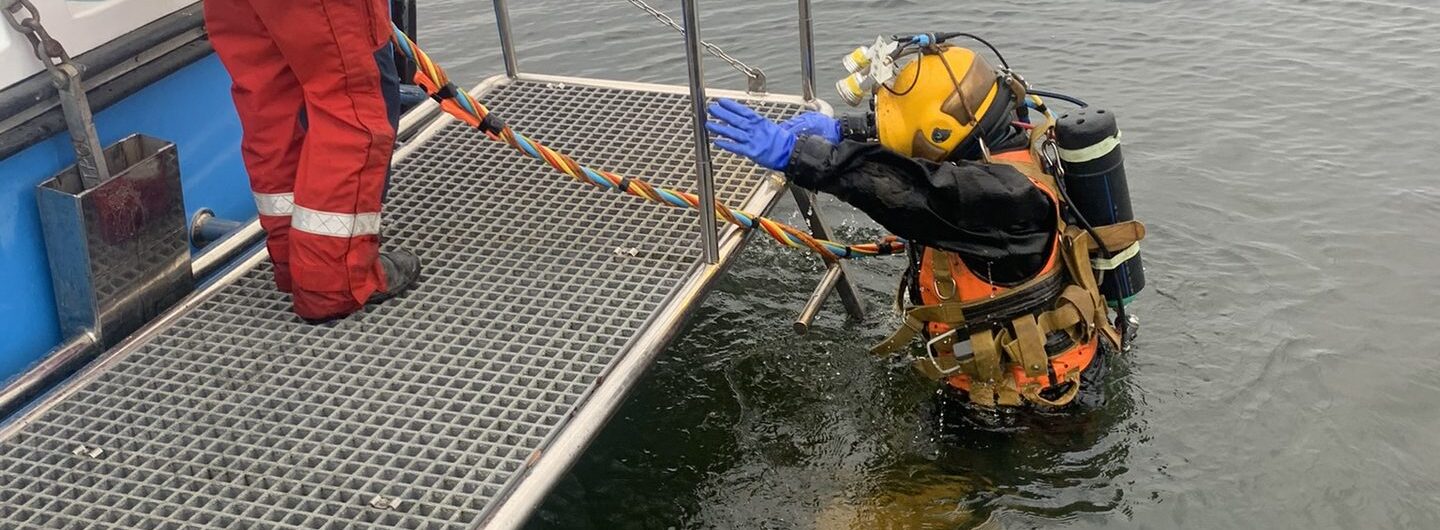
These are works carried out by divers or with underwater equipment below the waterline — from inspection and measurement, through cutting and welding, to concreting and assembly. In hydrotechnics they are often the only rational alternative to dewatering: instead of building a cofferdam and draining the area, the work is done directly underwater, which shortens the time and lowers the cost.
Underwater inspections and surveys
The basis for diagnosing any structure on the water. An underwater survey covers the assessment of the structure (wall, piles, capping beams, abutments), measurement of losses and thickness, inspection of the bed and detection of scour, and photo/video documentation. Without it, assessing the condition of a quay or a damming structure is incomplete — the most serious damage develops precisely underwater.
Scope of underwater works
- Inspections and surveys — technical assessment of structures, documentation, measurements.
- Underwater cutting and welding — dismantling and repair of steel elements.
- Underwater concreting — fills, underpinning, repairs of reinforced-concrete structures.
- Repairs of quays and sheet pile walls — sealing, patching perforation, eliminating cavities.
- Assembly and dismantling — fenders, pipelines, underwater elements.
- Cleaning and desilting — removing deposits around structures (linked with dredging works).
When underwater works pay off
Whenever dewatering would be more expensive or impossible — in deep water, with strong inflow, or when the water body must stay in service. They also allow a rapid response: assessing scour or providing temporary protection does not require weeks of preparation. Combined with repair “from the land side”, they complete the picture — the full scope of works at the water–soil interface.
Safety and organisation
Underwater works are high-risk works, carried out under the rules governing diving operations: by trained teams, with standby cover, communication and supervision. For the client, what counts is that the work is documented and run in accordance with procedures — not merely “done”.
FAQ
Can a quay repair be done without dewatering?
In most cases, yes. Underwater cutting, welding and concreting allow the submerged part to be repaired without a cofferdam and pumping.
Can you weld and concrete underwater?
Yes — these are standard underwater techniques, used for repairs of steel and reinforced-concrete structures.
Do you need an assessment or repair of the underwater part of a structure? We will carry out the inspection, select the technology and run the underwater works within hydrotechnical construction — with documentation and supervision. Get in touch.